

Meta Title
Why the Mind Feels Busy All the Time | Causes of Mental Overload & How to Calm Your Mind
Meta Description
Discover why your mind feels busy all the time and how mental overload affects health and fitness. Learn simple, science-backed ways to calm racing thoughts and regain mental clarity.
Introduction: The Constant Noise Inside the Mind
Many people today say the same thing: “My mind never stops.” Even during rest, the brain jumps from one thought to another—work pressure, future worries, unfinished tasks, social media, and personal responsibilities. This constant mental activity can feel exhausting, overwhelming, and impossible to control.
A busy mind is not a personal failure. It is often the result of modern lifestyle habits, stress patterns, and lack of mental recovery. When the mind stays busy all the time, it directly affects mental health, physical fitness, sleep quality, focus, and emotional balance.
Understanding why the mind feels busy is the first step toward calming it. This article explains the root causes of mental overload, its impact on health and fitness, and practical, realistic ways to quiet the mind naturally.

What Does It Mean When the Mind Feels Busy?
A busy mind is a mental state where thoughts feel continuous, repetitive, and uncontrollable. Instead of focusing on one thing, the brain constantly multitasks internally.
Common signs of a busy mind include:
- Racing thoughts
- Difficulty concentrating
- Overthinking past events
- Worrying excessively about the future
- Feeling mentally tired even without physical work
This mental state keeps the nervous system in alert mode, making true relaxation difficult.
Why the Mind Feels Busy All the Time
There is no single reason. A busy mind usually develops from a combination of lifestyle, emotional, and environmental factors.
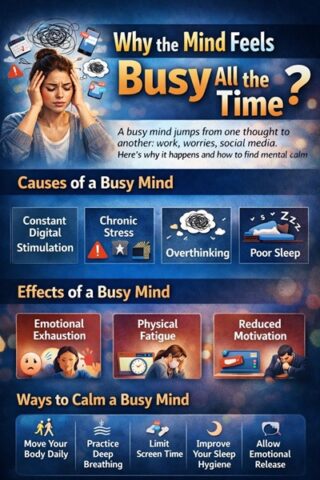
1. Constant Digital Stimulation
Smartphones, social media, emails, and notifications keep the brain in a state of continuous input.
- Endless scrolling overloads the brain with information
- Notifications interrupt natural focus
- The mind never gets quiet time
The brain needs silence to reset. Without it, thoughts pile up.
2. Chronic Stress and Mental Pressure
Stress is one of the biggest reasons the mind feels busy.
Sources of daily stress include:
- Work deadlines
- Financial worries
- Family responsibilities
- Health concerns
When stress becomes chronic, the brain stays in survival mode, constantly scanning for problems to solve. This leads to nonstop thinking.
3. Overthinking and Mental Loops
Overthinking keeps the mind trapped in repeated thought patterns.
Examples include:
- Replaying conversations
- Imagining worst-case scenarios
- Self-criticism
- Regret about past decisions
These mental loops consume energy but rarely provide solutions.
4. Lack of Physical Activity
Physical movement helps release mental tension. When the body is inactive:
- Stress hormones build up
- Mental restlessness increases
- Sleep quality worsens
A sedentary lifestyle often leads to an overactive mind.
5. Poor Sleep Quality
Sleep is essential for mental recovery. When sleep is disturbed:
- Thoughts become scattered
- Emotional control weakens
- Focus decreases
A tired brain struggles to filter unnecessary thoughts, making the mind feel crowded.
6. Multitasking and Mental Overload
Doing too many things at once confuses the brain.
- Switching tasks frequently increases mental fatigue
- The brain never fully completes one thought
- Attention becomes fragmented
Multitasking creates the illusion of productivity but increases mental chaos.
7. Emotional Suppression
Ignoring emotions does not make them disappear.
Unprocessed emotions such as:
- Anger
- Fear
- Sadness
- Guilt
stay active in the subconscious mind. This emotional tension shows up as constant mental noise.
How a Busy Mind Affects Health & Fitness
Mental overload does not stay in the head—it impacts the entire body.
Impact on Physical Health
A busy mind can lead to:
- Headaches and muscle tension
- Digestive issues
- Weakened immune system
- Hormonal imbalance
Chronic mental stress increases inflammation and physical fatigue.
Impact on Fitness and Performance
When the mind is overloaded:
- Motivation to exercise decreases
- Recovery becomes slower
- Focus during workouts drops
- Energy levels remain low
Mental calm is essential for consistent fitness progress.
Impact on Mental Health
A constantly busy mind increases the risk of:
- Anxiety
- Burnout
- Mood swings
- Emotional exhaustion
Mental clarity is a foundation of long-term well-being.
The Mind–Body Connection Explained Simply
The brain and body communicate constantly through the nervous system.
- A stressed mind tightens muscles
- A calm body signals safety to the brain
- Movement helps release mental tension
This is why health and fitness routines are powerful tools for mental calm.
Practical Ways to Calm a Busy Mind Naturally
Calming the mind does not require extreme techniques. Small, consistent habits work best.
1. Move Your Body Daily
Physical activity releases excess mental energy.
Effective options include:
- Walking outdoors
- Light strength training
- Yoga or stretching
- Slow cycling
Even 20–30 minutes a day can significantly quiet racing thoughts.
2. Practice Single-Tasking
Train your brain to focus on one task at a time.
- Eat without screens
- Work on one task for 25–30 minutes
- Avoid constant app switching
Single-tasking reduces mental fragmentation.
3. Limit Digital Overload
Create boundaries with technology:
- Turn off non-essential notifications
- Avoid screens before bedtime
- Schedule phone-free time
Silence allows the mind to reset naturally.
4. Use Breath Awareness
Slow breathing sends calming signals to the brain.
Simple technique:
- Inhale slowly for 4 seconds
- Exhale slowly for 6 seconds
- Repeat for 3–5 minutes
This activates the body’s relaxation response.
5. Write Your Thoughts Down
Mental clutter often comes from trying to remember everything.
- Write tasks and worries on paper
- Journal before sleep
- Empty the mind onto a page
This creates mental space and clarity.
6. Improve Sleep Hygiene
Quality sleep is essential for mental calm.
Healthy sleep habits include:
- Fixed sleep and wake times
- Dark, quiet bedroom
- No screens 60 minutes before bed
A rested brain handles thoughts more efficiently.
7. Allow Emotional Release
Healthy emotional expression reduces mental pressure.
- Talk to someone you trust
- Express emotions through writing
- Practice self-compassion
Emotions processed = thoughts reduced.
How Fitness Routines Help Calm the Mind
Exercise is one of the most effective mental health tools.
Benefits include:
- Reduced cortisol (stress hormone)
- Improved mood chemicals like serotonin
- Better focus and memory
- Deeper sleep
This makes fitness essential for mental balance, not just physical appearance.
Building a Long-Term Calm Mind Lifestyle
Mental calm is not about stopping thoughts—it’s about changing your relationship with them.
Long-term strategies:
- Consistent movement
- Balanced nutrition
- Mental breaks during the day
- Realistic expectations
A calm mind develops through habits, not force.
Internal Linking Suggestions (www.dailyhealthportal.com)
You can internally link this article to:
- “Mental Health Tips for Stress Management”
- “How Exercise Improves Mental Health”
- “Best Yoga Poses for Relaxation”
- “Healthy Sleep Habits for a Better Life”
These links improve SEO, topical authority, and user engagement.
Conclusion: A Busy Mind Is a Signal, Not a Problem
A constantly busy mind is not something to fight—it is something to understand. It often signals stress, overload, lack of movement, or emotional imbalance. By making small, intentional changes in daily habits, you can gradually bring calm, clarity, and balance back into your life.
A calmer mind leads to better health, stronger fitness, improved focus, and emotional stability. Start small, stay consistent, and allow your mind the rest it deserves.
FAQs: Why the Mind Feels Busy All the Time
1. Is it normal for the mind to feel busy all the time?
Yes, it is common in modern life due to constant stimulation, stress, and multitasking. However, a continuously busy mind should not be ignored, as it can affect mental health, sleep, and overall well-being.
2. Can exercise really calm a busy mind?
Yes, regular exercise is one of the most effective ways to calm the mind. Physical movement reduces stress hormones, improves mood, and helps release mental tension naturally.
3. Why does my mind feel busy even when I am resting?
A busy mind during rest often comes from unresolved stress, emotional suppression, or digital overstimulation. The brain stays active because it has not received a signal that it is safe to relax.
4. Does poor sleep make the mind more active?
Poor sleep significantly increases mental activity. When the brain is tired, it struggles to filter unnecessary thoughts, leading to racing thoughts and mental fatigue throughout the day.
5. How long does it take to calm a busy mind?
Mental calm develops gradually. Some relief can be felt within days of lifestyle changes, while deeper calm usually builds over weeks through consistent habits like exercise, better sleep, and reduced screen time.
6. Can meditation help with a constantly busy mind?
Yes, meditation helps increase awareness of thoughts without reacting to them. Over time, this reduces overthinking and improves mental clarity and emotional control.
7. Is a busy mind linked to anxiety?
Often, yes. A constantly busy mind can be a symptom of anxiety or chronic stress. Addressing lifestyle factors and seeking professional support when needed can help manage it effectively.